
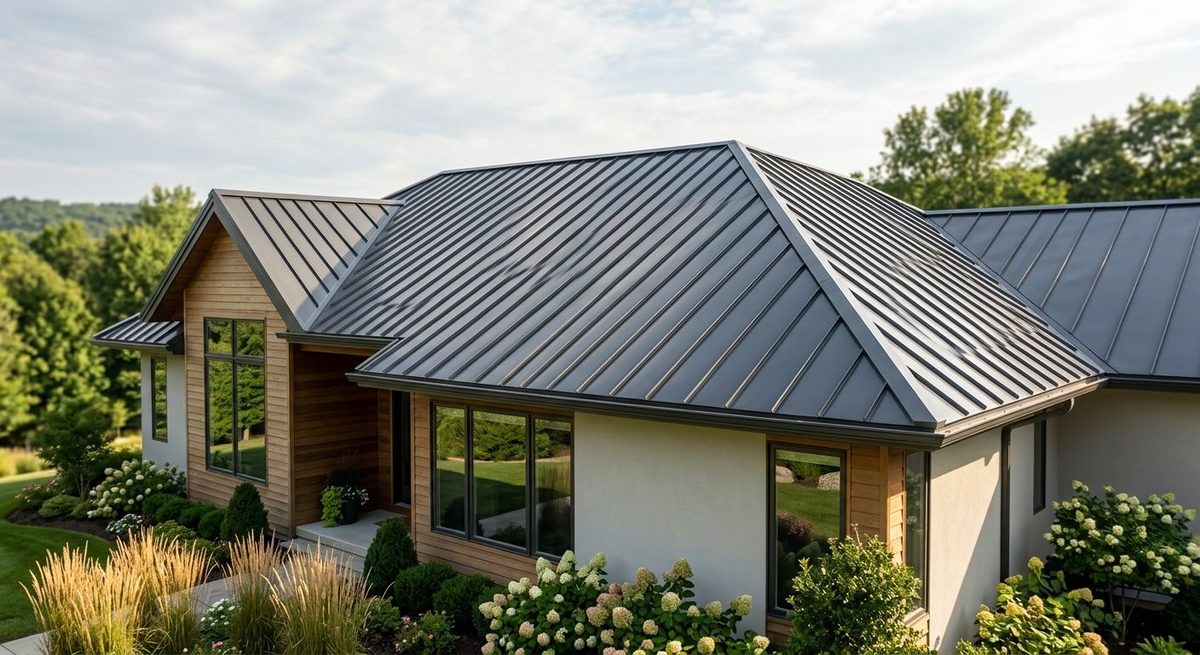
“Standing seam” describes how metal panels join. It isn’t one product. Every manufacturer makes several profiles, and the seam type, attachment method, and minimum roof pitch change from one profile to the next. So the useful comparison isn’t logo against logo. It’s one named panel system against another, on your roof. Here’s how to compare standing seam brands in 2026, and what we install around Denver, NC and Lake Norman.
Short version
- Compare named panel systems, not brand names. A quote that just says “standing seam metal” isn’t comparable to anything.
- The two big choices are snap-lock (panels snap together) and mechanical lock (seams are crimped with a field seamer). Neither is automatically better.
- Minimum roof pitch matters: some profiles need 3:12 or steeper, and mechanically seamed panels can go lower.
- We install Metal Roofing Systems (MRS) standing seam and confirm the right system for your roof at inspection.
Why this matters
Two metal roof quotes can use the same words and describe very different roofs. Seam height, seam type, clips, panel gauge, finish, and how eaves, valleys, walls, and skylights are detailed all differ. Get those specifics in writing before deciding which quote is better.
If you’re weighing metal after storm damage, keep the damage inspection separate from the material decision. Get the roof inspected and the damage photo-documented first. The material choice comes after.
What makes the best standing seam metal roof system?
- Named panel profile: the manufacturer and exact product line should be in the written estimate.
- Seam and attachment: snap-lock or mechanically seamed, and concealed clips or another attachment.
- Fit for your roof: the roof’s pitch, penetrations, and transitions checked against that profile’s installation requirements.
- Detail work: how the proposal handles eaves, ridges, valleys, walls, and skylights. A good panel can’t make up for vague flashing details.
- Finish and warranty: the finish spec (for example, Kynar 500® / PVDF) and the warranty documents for the exact system.
- Installer accountability: who installs it, what’s included, and how the site is left.
The MRS standing seam systems we install, at a glance
These are Metal Roofing Systems, Inc. profiles as MRS publishes them. We confirm the right one for your roof at inspection.
| MRS system | Seam type | Best for | Key limitation |
|---|---|---|---|
| System 1000 (1.5″ snap lock) | Snap-lock, concealed clips | Most residential roofs at 3:12 and steeper | Typical minimum pitch 3:12 over solid substrate |
| System 1500 (1.5″ mechanical lock) | Mechanically seamed (90° / 180°) | Field-formed historic look, high wind loads, lower slopes | Field seamer required |
| System 2000 (1.75″ structural snap-lock) | Structural snap-lock | A taller seam without a mechanical seamer | Typical minimum pitch 3:12 over solid substrate |
| System 2500 (2″ mechanical lock) | Mechanically seamed, single or double lock | High wind and low slope (as low as 1/2:12) | Field seamer required; more specialized install |
Specs as published by Metal Roofing Systems, Inc. Materials commonly include Galvalume®, aluminum, and copper with a Kynar 500® (PVDF) finish.
Snap-lock vs mechanical lock: which is better?
Neither, on every roof. Snap-lock panels go together without a seaming machine, which suits most residential roofs at moderate to steep pitch. Mechanically seamed panels are crimped in the field, which suits lower slopes, higher wind exposure, and the look of a traditional field-formed roof. The right answer depends on your roof’s pitch, layout, and wind exposure, so ask the installer to explain why the proposed seam fits your house.
How to compare metal roof quotes from other brands
You may get quotes built on other manufacturers’ panels. That’s fine. Put them side by side on the same points:
- Manufacturer, exact panel profile, and seam height
- Snap-lock or mechanical lock, and the attachment method
- Panel material, gauge, and finish
- Minimum pitch for that profile versus your roof’s actual pitch
- How eaves, ridges, valleys, walls, and penetrations are detailed
- Tear-off, underlayment, and decking scope
- The written warranty documents for that exact system
If something is missing from one quote, ask for it in writing instead of assuming the contractors mean the same thing. The better comparison is between complete scopes, not brand lists.
Thinking about a standing seam roof?
Get a free inspection and a written scope that names the exact MRS system for your roof.
A note on GAF credentials and metal roofs
Campbells Precision Roofing is a GAF Master Elite® and President’s Club contractor (NC Licensed Contractor #101889). GAF’s enhanced warranties, including Golden Pledge®, apply to qualifying GAF roofing systems, so don’t assume one applies to a metal roof. For metal, ask for the warranty documents for the specific panel system and finish. If you end up preferring shingles, see our GAF shingle lines comparison.
Which standing seam system should you choose?
Start with your roof’s pitch and exposure, then pick the seam type, then the profile. For most homes at 3:12 or steeper, a snap-lock profile like MRS System 1000 is the usual starting point. Lower slopes, high wind exposure, or a traditional field-formed look point toward a mechanically seamed system. Whatever brand a quote uses, make sure it names the exact system and details your roof’s transitions.
If a leak is the immediate problem, settle the repair-or-replace question before committing to metal. See can a roof leak be fixed without replacing the whole roof?
FAQ
What’s the best standing seam metal roof brand in 2026?
The better question is which named panel system fits your roof. We install Metal Roofing Systems (MRS) standing seam. Whatever brand you consider, compare the exact profile, seam type, attachment, finish, and installation details.
Is a snap-lock roof better than a mechanically seamed roof?
Neither is automatically better. Snap-lock suits most residential roofs at moderate to steep pitch, and mechanical lock suits lower slopes and higher wind exposure.
What’s the difference between snap-lock and mechanical-lock standing seam?
Both hide the fasteners under raised seams. Snap-lock panels click together over concealed clips. Mechanical-lock panels are closed with a field seaming tool into a single or double lock, which suits lower slopes and higher wind loads. MRS makes both: System 1000 is a 1.5-inch snap-lock panel for roofs 3:12 and steeper, and System 1500 is a 1.5-inch mechanical-lock panel rated down to 1:12.
What should a standing seam metal roof estimate include?
The manufacturer, exact panel profile, seam and attachment method, material and finish, roof-specific flashing details, tear-off scope, and the warranty documents for that system.
What roof pitch does standing seam need?
It depends on the profile. MRS lists a typical minimum of 3:12 for its System 1000 and 2000 snap-lock panels, and as low as 1/2:12 for its System 2500 mechanical-lock panel.
Does GAF Golden Pledge cover a standing seam metal roof?
Don’t assume it does. GAF’s enhanced warranties apply to qualifying GAF roofing systems. Ask for the metal system’s own warranty documents.
Should I switch to metal after hail damage?
Get the roof inspected and the damage photo-documented first, then decide on material. Metal resists the cracking and granule loss hail causes on shingles, though heavy hail can still dent some panels cosmetically.
One last thing
A brand comparison can’t tell you whether your house needs a new roof. The first question is still what the inspection found, and the panel shortlist comes after that. For color choices, see our metal roofing colors guide.
Campbells Precision Roofing · Denver, NC 28037 · (704) 280-5996 · NC Licensed Contractor #101889