
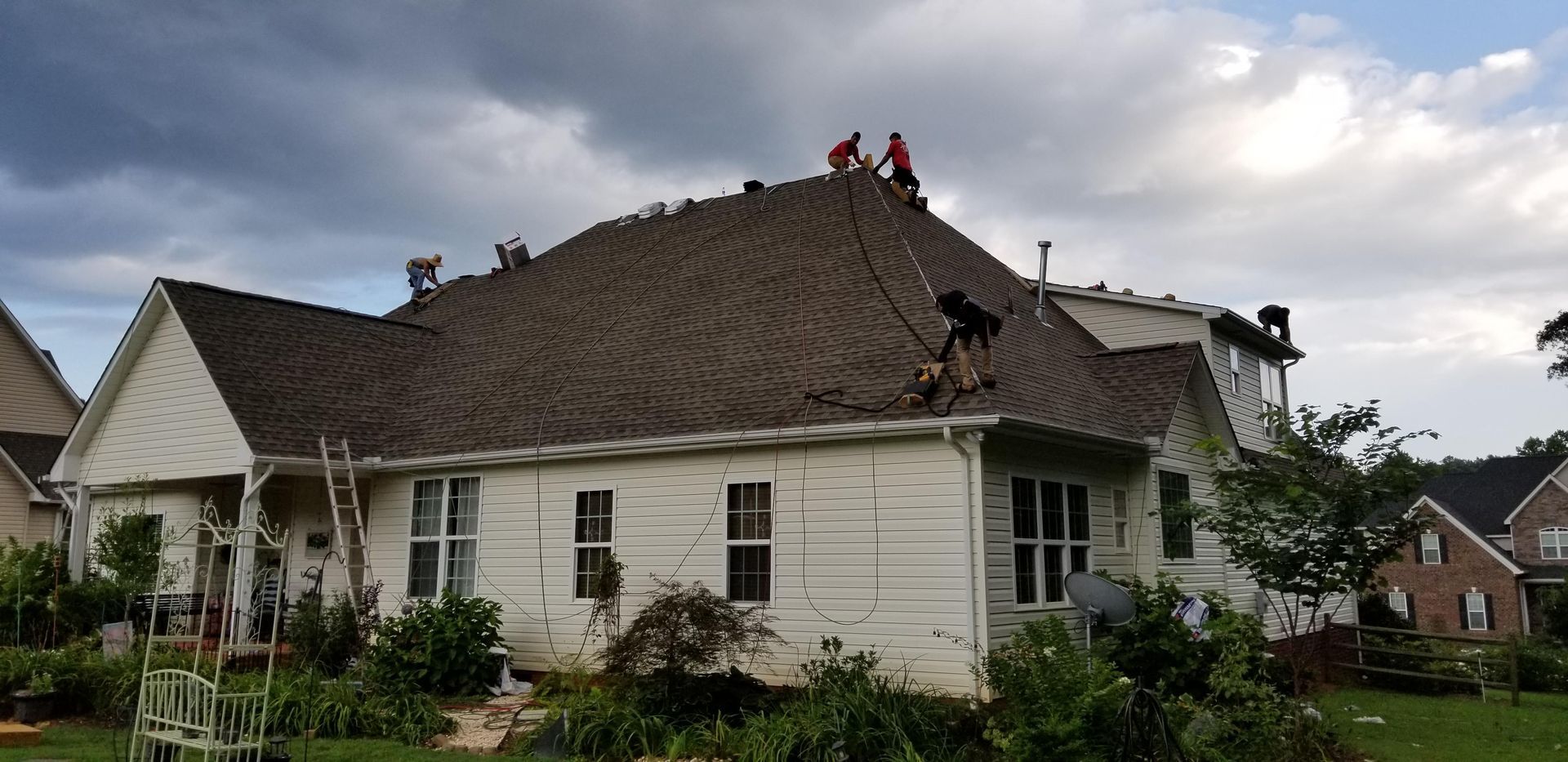
A thunderstorm rolls across Lake Norman, the wind picks up, and an hour later water is dripping through the kitchen ceiling. Whether a limb came down, shingles blew off, or an old pipe boot gave out, an active roof leak is stressful. The first few hours come down to a few simple, sensible steps.
We’re Campbells Precision Roofing, based in Denver, NC 28037. This guide covers what to do first when your roof is leaking right now: stay safe, protect the inside of your home, take photos, and get in touch. Once the water is under control, a proper inspection tells you whether you need a repair or a new roof.
1. Make sure everyone is safe
Water inside the house can create hazards that matter more than the roof itself:
- Stay off the roof. Please don’t climb up during or right after a storm. Wet shingles are slick, gusts can knock you off balance, and damaged areas may not hold your weight.
- Keep water away from electricity. If water is coming through or near a light fixture, ceiling fan, or outlet, keep people away from it. If you can reach your breaker panel safely and it’s dry, switch off power to that area. If you’re unsure, or the panel area is wet, don’t touch it and call an electrician.
- Watch the ceiling. A ceiling that sags or bulges with water can give way. Keep kids and pets out of the room and put a bucket underneath.
- Steer clear of downed lines. If a tree took down a power line, stay well away and call your utility company or 911.
2. Protect the inside of your home
Once everyone is safe, focus on limiting the water damage inside:
- Catch the water with buckets, pots, or storage bins, and empty them before they overflow.
- Move valuables and electronics away from the drip, along with furniture, rugs, and anything made of paper or fabric.
- Cover what you can’t move with plastic sheeting or a drop cloth.
- Mop up standing water so it doesn’t soak into floors.
Keep in mind that a stain rarely sits directly under the opening in the roof. Water runs along the decking and rafters before it drips, so the spot on your ceiling may be a few feet away from where the water is actually getting in. We trace it back to the source during the inspection.
3. Take photos for your own records
From inside the house, and from the ground outside when it’s safe:
- Photograph the leak, the drip, and any interior stains or wet materials.
- Photograph visible debris, missing shingles, fallen limbs, or gutter sections that came loose.
- Write down the date and time of the storm and when you first noticed water, and note whether the leak gets worse during heavy rain.
Keep your photos together in one place for your records. They also help us know where to look first when we get to your house.
4. Call or text us
Call or text (704) 280-5996. Our office hours are Monday through Friday, 8:00 AM to 5:00 PM. For storm emergencies, call or text and we’ll respond as soon as we can.
When you reach out, it helps to tell us your address, where the water is showing up inside, and roughly when it started. If you took photos, send a few by text.
Roof leaking right now?
Call or text (704) 280-5996. For storm emergencies, we’ll respond as soon as we can.
Emergency tarping: temporary protection, not the fix
If there’s an active leak, we’ll talk through temporary protection like a tarp. After a storm, a temporary tarp or dry-in can limit further damage and keep the inside of your home dry while you decide on next steps. We’ll explain the options when we look at the roof.
Two things to keep in mind:
- A tarp is temporary. It’s there to stop more water from getting in, not to repair the roof. The opening still needs a proper repair, or the roof needs replacing.
- Don’t tarp it yourself in bad weather. Climbing a wet roof with a sheet of plastic in the wind is how people get hurt. It’s worth the call.
After the storm: repair or replace?
Once the emergency is handled, a free inspection tells you what the roof needs. We check the shingles, flashing, vents, pipe boots, and gutters for storm damage and any spots where water is getting in, and we photograph what we find. You get photos you keep, a plain-language summary, and an honest recommendation.
Plenty of leaks don’t need a new roof. If the rest of the roof is sound, a leak at a pipe boot, a flashing joint, or a few damaged asphalt shingles can usually be repaired on its own. Our guide on whether a roof leak can be fixed without replacing the whole roof walks through that decision in detail.
Replacement makes more sense when leaks come from several places, the decking is soft, or the shingles are worn out across the roof. When a roof needs replacing, it’s a full tear-off down to the deck. We never install new shingles over an old roof. See our roof repair and replacement page for how that works.
If hail or high wind caused the leak, our storm damage inspections page explains how we document what we find, and our hail damage inspection guide for Lake Norman covers what hail does to a roof. Homeowners in Huntersville can also read about roof replacement after storms.
Leaking around a skylight? Most skylight leaks come from failed flashing or an aging unit, not the glass; see skylights. Water pouring over the roof edge? See gutters.
Watch out for storm chasers
After big storms, out-of-town crews often go door to door. Before you let anyone on your roof, check for a North Carolina license, a local address, and a track record you can verify. Our guide on how to vet a roofer in North Carolina covers what to ask.
We’re a local crew based in Denver, a GAF Master Elite® and President’s Club contractor, and NC Licensed Contractor #101889. GAF is our primary shingle manufacturer, and we’re also a CertainTeed ShingleMaster PRO, a Brava Authorized Contractor, and VELUX Certified. FORTIFIED Roof™ practices are available where they fit the project.
Serving Denver and Lake Norman
Denver is home base, and we work all around the lake. See our pages for Denver, Sherrills Ford, Mooresville, Cornelius, and Huntersville, or the full list of areas we serve across Lincoln, Gaston, Mecklenburg, Catawba, Iredell, and Cleveland counties.
FAQ
What should I do if my roof is leaking right now?
Move valuables and electronics away from the drip, catch the water, and take photos of the leak for your records. Please don’t climb onto the roof. Then call or text (704) 280-5996.
Can I reach you after hours?
Our hours are Monday–Friday, 8:00 AM to 5:00 PM. For storm emergencies, call or text (704) 280-5996 and we’ll respond as soon as we can.
Do you offer emergency tarping?
If there’s an active leak after a storm, we’ll talk through temporary protection like a tarp to keep water out until the roof is properly repaired or replaced. We’ll explain the options when we look at the roof.
Does a leak mean I need a new roof?
Not necessarily. Many leaks at pipe boots, flashing, or a few damaged shingles can be repaired on their own. We show you photos and recommend the smaller fix when it’s enough.
One last thing
An active leak is urgent, but the first steps are simple: stay safe, protect what’s inside, take photos, and get in touch. A tarp buys time, and a free inspection gives you a straight answer.
Call or text (704) 280-5996, or contact us for a free roof inspection in Denver and around Lake Norman.
Campbells Precision Roofing · 7730 Campground Rd, Denver, NC 28037 · (704) 280-5996 · NC Licensed Contractor #101889